How to Find Your Vedic Rising Sign (Lagna)


If you open a Vedic birth chart for the first time, the very first thing a Jyotish reader looks for is not the Sun or the Moon. It is the Lagna, the rising sign. In Western astrology the same point is called the Ascendant. In Jyotish it is the starting point of the whole chart, the place from which every house is counted. This guide explains what the Lagna is, why it needs an accurate birth time, and how you can find yours in a few minutes.
As always, Jyotish is best used as a framework for reflection. Nothing here is a prediction, and traditions differ in the details.

Amber subscription
- Chart management
- Chart reports and interpretations
- Horoscope matching
- Vargas up to D-60
- Varshaphal, Prasna, Muhurta
- Bhava Chalit and Jaimini Chakras
- 4 Dasas with up to Pratyantardasa
- Basic Gochara and Panchanga search

Emerald subscription
Everything in Amber +
- Transsaturns, Upagrahas
- Vargas up to D-150 and all Chakras
- Mathematical rectification technics
- All Dasas with up to Pranadasa
- Detailed Ashtakavarga calculation, Shadbala
- Full-featured Gochara, Muhurta, Panchanga search
- All settings available in JMC Calculator

Ruby subscription
Everything in Emerald +
- 180 tokens included
- Deep dive analysis with AI assistant
- Jyotish Diary included
- Increased bonus for each affiliate in our affiliate program
- Research feature JMC Databank
- Unlimited chart quota
- Auto calculations for muhurta and rectification
What is the Lagna?
The word lagna is often translated as "that which is attached" or "the point of connection". Astronomically, it is the zodiac sign that was rising over the eastern horizon at the exact moment and place of your birth. Because the Earth turns on its axis, all twelve signs rise over the horizon once a day. Each sign takes about two hours to pass, although the exact time varies with the sign and with your latitude.
In a Vedic chart the Lagna sign becomes the first house. The sign after it becomes the second house, and so on around the wheel. The planets are then read by the house they occupy. Without the Lagna, a chart has planets but no houses, so the Lagna is what turns a list of positions into a map of life areas.
Why the Lagna matters in Jyotish
Many practitioners describe the Lagna as the "self" of the chart: your body, your general temperament and the way you meet the world. The Moon sign (Rashi) is often described as the inner mind and emotional nature, while the Lagna is the outer frame in which life unfolds. You can read more about the Moon in our guide to what a Moon sign is and why it matters.
Two practical points explain why Jyotish readers start here:
- Houses depend on it. The first house is the Lagna, the seventh house is the sign opposite, the tenth house relates to career and public life, and so on. Change the Lagna and every house changes.
Sidereal, not tropical
Vedic astrology uses the sidereal zodiac, which is measured against the fixed stars. Western astrology typically uses the tropical zodiac, which is tied to the seasons. The two differ by roughly 24 degrees at present, a gap called the ayanamsha. For the Lagna this often means that your Vedic rising sign is the sign before the one you know from a Western chart, though not always. If this is new to you, start with our simple explanation of sidereal vs tropical zodiac.
What you need to find your Lagna
Three pieces of data are essential:
- Date of birth. Day, month and year.
- Time of birth. As exact as possible. A birth certificate or hospital record is the best source. If you only know "around noon", the Lagna may still be uncertain.
- Place of birth. The city or town, because the eastern horizon depends on latitude and longitude.
Of the three, time is the most sensitive. Because the rising sign changes roughly every two hours, an error of even 30 minutes can move you close to a sign boundary, and an error of a couple of hours will usually put you in a different sign.
How to find your Lagna step by step
Step 1. Gather your birth details. Look for a birth certificate, a baby book or a family record.
Step 2. Open a Vedic chart calculator. The JMC Calculator builds a natal chart in the Vedic tradition. If you only want to explore, you can try the free demo. There is also an "I am new to Jyotish" option that adds simpler explanations next to the chart.
Step 3. Enter your date, time and place. Choose your birthplace from the list so that the latitude and longitude are filled in correctly.
Step 4. Find the Lagna in the chart. In a North Indian style chart, the Lagna is the top central diamond, which is always the first house. The number written in that house tells you the sign. In a South Indian chart the Lagna is marked with a diagonal line in one of the signs.
What if you do not know your birth time?
This is very common. A few options exist:
- Ask family. A parent, grandparent or older relative may remember the time, or a family album may record it.
- Birth time rectification. Jyotish has traditional techniques for estimating a likely birth time from known life events. The JMC Calculator includes rectification tools, and it is best treated as an estimate rather than a certainty.
Lagna and Moon sign: do not mix them up
Beginners often ask which sign is their "real" one. In Jyotish, the answer is that each tells you something different. The Lagna describes the frame of the chart and the houses. The Moon sign describes the mind and is used for many transit and timing methods. The Sun sign is also read, but it plays a smaller role in everyday Jyotish than it does in Western horoscopes. Reading all three together gives a fuller picture than choosing one.
Next steps once you know your Lagna
After you have found it, try these gentle next steps:
- Follow our step-by-step guide to reading your Vedic birth chart (kundli).
- Look at the nakshatra of your Lagna and Moon in our guide to the 27 nakshatras.
- Ask SIVA, the AI assistant at j108.net/chat, to explain your chart in plain English. SIVA can calculate charts interactively and answer follow-up questions in conversation, which is helpful when you are learning the vocabulary.
Frequently asked questions
Is the Lagna the same as the Ascendant? They refer to the same point, the degree of the zodiac rising on the eastern horizon at birth. The difference is that Jyotish measures it in the sidereal zodiac, so the sign can differ from a Western chart.
Why does my Vedic rising sign differ from my Western one? Because of the ayanamsha, the difference between the sidereal and tropical zodiacs. At present it is about 24 degrees, so many people find their Vedic Lagna is one sign earlier. Some people stay in the same sign if their rising degree is late in the sign.
How accurate does my birth time need to be? As accurate as you can get it. A few minutes rarely matter, but half an hour can matter near a sign boundary, and an hour or more often changes the Lagna. If you are unsure, treat the Lagna as provisional.
Find your Lagna today
Your rising sign is the doorway into the rest of your chart. Enter your birth details in the free demo of the JMC Calculator, look for the first house, and then ask SIVA, your AI assistant, to explain what you see in simple terms. Take it slowly, stay curious, and use what you learn as a tool for reflection.
Amber subscription
- Chart management
- Chart reports and interpretations
- Horoscope matching
- Vargas up to D-60
- Varshaphal, Prasna, Muhurta
- Bhava Chalit and Jaimini Chakras
- 4 Dasas with up to Pratyantardasa
- Basic Gochara and Panchanga search
Emerald subscription
Everything in Amber +
- Transsaturns, Upagrahas
- Vargas up to D-150 and all Chakras
- Mathematical rectification technics
- All Dasas with up to Pranadasa
- Detailed Ashtakavarga calculation, Shadbala
- Full-featured Gochara, Muhurta, Panchanga search
- All settings available in JMC Calculator
Ruby subscription
Everything in Emerald +
- 180 tokens included
- Deep dive analysis with AI assistant
- Jyotish Diary included
- Increased bonus for each affiliate in our affiliate program
- Research feature JMC Databank
- Unlimited chart quota
- Auto calculations for muhurta and rectification
Other articles in this category
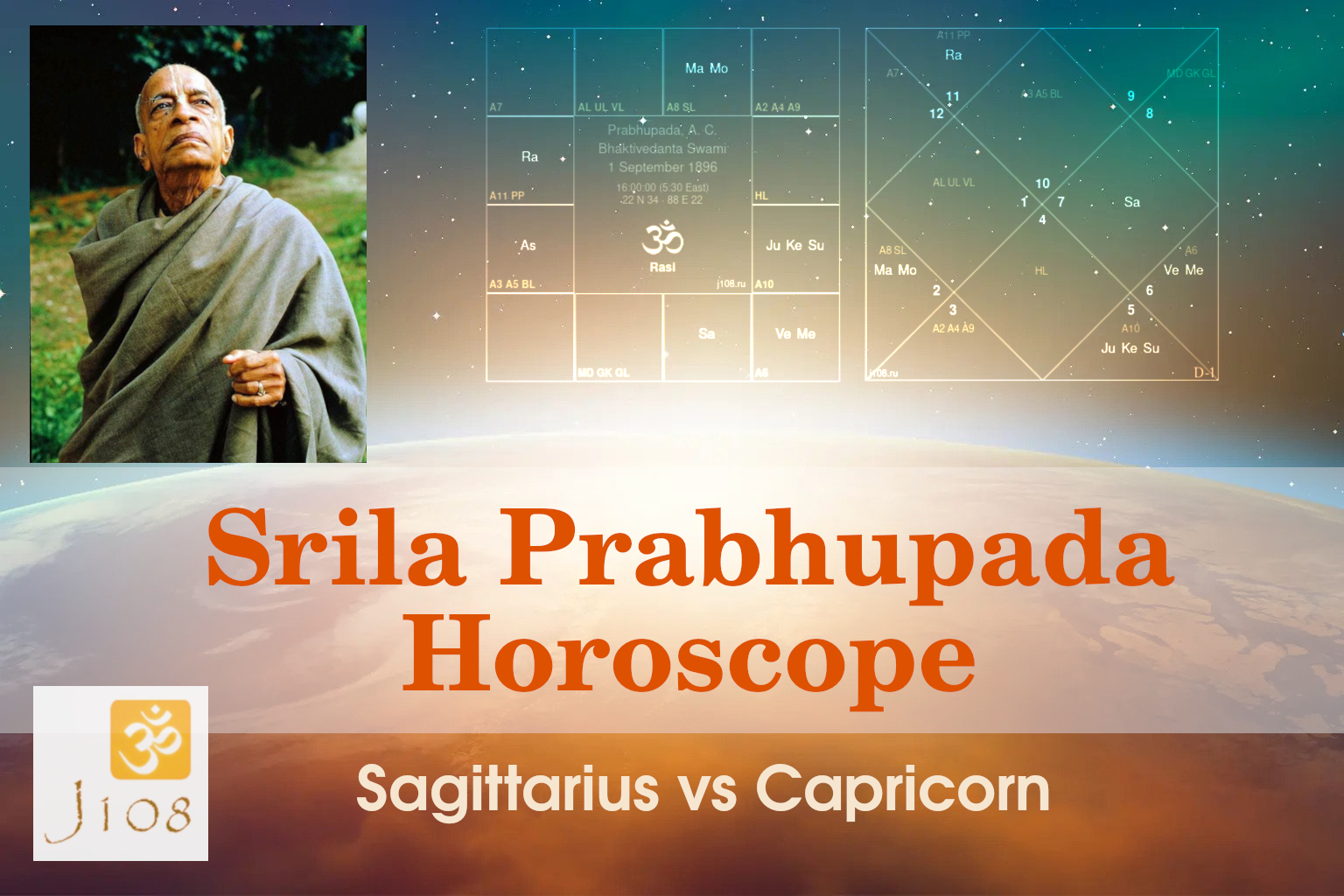
- Srila Prabhupada's horoscope: Saggitarius or Capricorn? 5 June 2023
- The death of Princess Diana in the car accident. Jyotish astrological analysis 7 June 2023
- Leonardo DiCaprio. A story of success in Rahu and Jupiter Mahadasa 16 June 2023
- Louis Pasteur. Microbilogy combinations in Jyotish 22 June 2023
- How to Read Your Vedic Birth Chart (Kundli) Step by Step 16 November 2026
👉 How to Find Your Vedic Rising Sign (Lagna)
You may also like


First time on this website? 👉 Get to know more about us! 👈

 Digest


Comments (0)