What Is a Moon Sign (Rashi) and Why It Matters in Jyotish

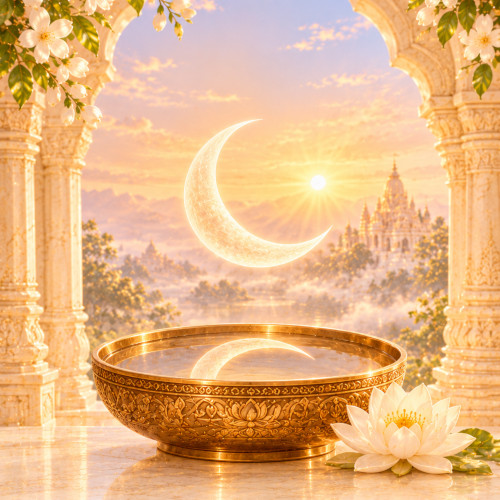
If you have ever read a Vedic horoscope, you have probably noticed that it begins with the Moon. In Jyotish, the Sanskrit word for the Moon sign is Rashi (also written Raashi or Rasi), and for many practitioners it is the most personal sign in the whole chart. This guide explains what a Moon sign is, why it often differs from the Sun sign you know from newspapers, and how to find yours.
Amber subscription
- Chart management
- Chart reports and interpretations
- Horoscope matching
- Vargas up to D-60
- Varshaphal, Prasna, Muhurta
- Bhava Chalit and Jaimini Chakras
- 4 Dasas with up to Pratyantardasa
- Basic Gochara and Panchanga search

Emerald subscription
Everything in Amber +
- Transsaturns, Upagrahas
- Vargas up to D-150 and all Chakras
- Mathematical rectification technics
- All Dasas with up to Pranadasa
- Detailed Ashtakavarga calculation, Shadbala
- Full-featured Gochara, Muhurta, Panchanga search
- All settings available in JMC Calculator

Ruby subscription
Everything in Emerald +
- 180 tokens included
- Deep dive analysis with AI assistant
- Jyotish Diary included
- Increased bonus for each affiliate in our affiliate program
- Research feature JMC Databank
- Unlimited chart quota
- Auto calculations for muhurta and rectification
What is a Moon sign?
Your Moon sign is the zodiac sign the Moon occupied at the moment you were born. The Moon travels through all twelve signs in about 27 to 28 days, which means it spends roughly two and a quarter days in each sign. That is quick compared with the Sun, which stays in one sign for about a month.
In Vedic astrology the Moon represents the mind (Manas), emotions, instinctive reactions, comfort and the way we take in everyday experience. Because of this, the Moon sign is traditionally used as a lens for temperament and inner life, while the rising sign (Lagna) describes the body, outlook and the overall framework of the chart. Many teachers describe the Lagna as the stage and the Moon as the mood of the play. Traditions differ in emphasis, so treat these as reflective themes rather than fixed rules.
The twelve Rashis
The twelve signs are the same ones you know, with Sanskrit names:
- Mesha (Aries)
- Vrishabha (Taurus)
- Mithuna (Gemini)
- Karka (Cancer)
- Simha (Leo)
- Kanya (Virgo)
- Tula (Libra)
- Vrishchika (Scorpio)
- Dhanu (Sagittarius)
- Makara (Capricorn)
- Kumbha (Aquarius)
- Meena (Pisces)
Each sign has a ruling planet, an element and a quality, and these shape how the Moon expresses itself there. A Moon in Karka (Cancer), which the Moon itself rules, is often described as emotionally receptive, while a Moon in Dhanu (Sagittarius) is often described as optimistic and searching. These are traditional keywords, not guarantees, and the rest of the chart always adds nuance.
Why your Moon sign may differ from your Sun sign
The sign you know from magazines is your Sun sign in the tropical zodiac, which is tied to the seasons. Jyotish uses the sidereal zodiac, which is tied to the fixed stars. The gap between the two systems is called the ayanamsha and is currently around 24 degrees. For a deeper look, read our explainers Vedic vs Western Astrology: Why Your Sign May Be Different and Sidereal vs Tropical Zodiac Explained Simply.
Two things follow from this:
- Many people find that their sidereal Sun sign is the sign before their familiar tropical one.
- The Moon sign is a separate placement altogether. It can be the same as your Sun sign or entirely different, depending on the lunar phase on your birthday.
So if you feel your newspaper sign never quite described you, your Moon sign may offer a fresh perspective.
Why Moon sign matters in Jyotish
The Rashi is not just a personality label. It is used in several practical ways:
- Nakshatra and dasha. The Moon's exact degree decides your birth star, or Nakshatra, and the nakshatra decides where your Vimshottari dasha sequence starts. Read more in our upcoming guide, [The 27 Nakshatras](https://j108.net/<адрес статьи 6>).
- Transits (Gochara). Many Jyotish traditions read planetary transits counting from the natal Moon sign. See the JMC Calendar Gochara page for how transits are presented.
- Sade Sati. The famous seven-and-a-half-year Saturn period is defined by Saturn's position relative to your Moon sign. We cover it in [Sade Sati Explained](https://j108.net/<адрес статьи 7>).
- Compatibility. Kundli matching (Guna Milan) starts with the Moon sign and nakshatra of each person.
- Everyday timing. Panchanga and muhurta work often references the Moon's position for choosing timing. Explore the Panchanga overview.
Why birth time matters
Because the Moon changes sign roughly every two days, a birth on a day when the Moon crosses a sign boundary needs an accurate birth time to determine the correct Rashi. Time zone and daylight saving rules also matter, and mistakes here are among the most common reasons people get a different Moon sign from two sources. If you are unsure of your birth time, note it as approximate and treat the result with caution. Rectification techniques, which the JMC Calculator supports, can help narrow it down.
How to find your Moon sign
You do not need to calculate anything by hand. The simplest route:
- Open the JMC Calculator or try the free demo.
- Enter your date, time and place of birth.
- Look for the Moon in your chart; its sign is your Rashi, and its degree reveals your nakshatra.
If you are new to the subject, the "I am new to Jyotish" option provides simpler explanations. You can also ask SIVA, the J108 AI assistant at j108.net/chat, to explain what your Moon sign means in plain English and to answer follow-up questions in conversation.
How to use your Moon sign thoughtfully
Jyotish is best approached as a framework for reflection rather than a prediction machine. A few practical ideas:
- Read your Moon sign description as a starting point and compare it with your own experience.
- Notice which parts resonate and which do not. The Moon is only one factor, and the signs and houses of other planets matter too.
- Remember that traditions vary by region, school and teacher, so you may see slightly different interpretations.
None of this replaces professional advice of any kind. Think of it as a vocabulary for self-observation.
FAQ
Is my Moon sign the same as my zodiac sign? Not necessarily. Your familiar sign is usually the tropical Sun sign. Your Vedic Moon sign is the sidereal sign the Moon occupied at birth, and the two often differ.
Which is more important in Jyotish, the Sun sign or the Moon sign? Many Jyotish practitioners give the Moon sign and the Lagna the leading roles, while the Sun sign is read as one placement among others. Emphasis varies by tradition.
What if I don't know my birth time? You can still get an approximate Moon sign, but it may be uncertain if the Moon changed signs on your birth date. Ask family members for any records, or try the rectification tools in the calculator.
Does my Moon sign decide my compatibility with someone? It is one input among several. Kundli matching considers both Moon signs and nakshatras, and a thoughtful reading looks at the entire chart. See the horoscope matching tool.
Find your Rashi today
Ready to see your own Moon sign? Try the free demo of the JMC Calculator, then ask SIVA, your AI assistant, to explain your chart in simple terms. J108 (Jyotish Maha Charts) has been on the market for 13 years and also offers a Digest, Library and School if you want to keep learning.
Amber subscription
- Chart management
- Chart reports and interpretations
- Horoscope matching
- Vargas up to D-60
- Varshaphal, Prasna, Muhurta
- Bhava Chalit and Jaimini Chakras
- 4 Dasas with up to Pratyantardasa
- Basic Gochara and Panchanga search
Emerald subscription
Everything in Amber +
- Transsaturns, Upagrahas
- Vargas up to D-150 and all Chakras
- Mathematical rectification technics
- All Dasas with up to Pranadasa
- Detailed Ashtakavarga calculation, Shadbala
- Full-featured Gochara, Muhurta, Panchanga search
- All settings available in JMC Calculator
Ruby subscription
Everything in Emerald +
- 180 tokens included
- Deep dive analysis with AI assistant
- Jyotish Diary included
- Increased bonus for each affiliate in our affiliate program
- Research feature JMC Databank
- Unlimited chart quota
- Auto calculations for muhurta and rectification
Other articles in this category
- Have you ever wondered why Mercury gets Diblaba in the 1st house? 22 June 2023
- Importance of the 8th house in Muhurta 28 June 2023
- What Is Vedic Astrology? A Beginner's Guide to Jyotish 26 October 2026
- Vedic vs Western Astrology: Why Your Sign May Be Different 2 November 2026
- Sidereal vs Tropical Zodiac Explained Simply 3 November 2026
👉 What Is a Moon Sign (Rashi) and Why It Matters in Jyotish
- The 27 Nakshatras: A Complete Guide to Your Birth Star 12 November 2026
- Sade Sati Explained: Saturn's 7.5 Years and How to Get Through Them 13 November 2026
First time on this website? 👉 Get to know more about us! 👈

 Digest


Comments (0)