How to Read Your Vedic Birth Chart (Kundli) Step by Step

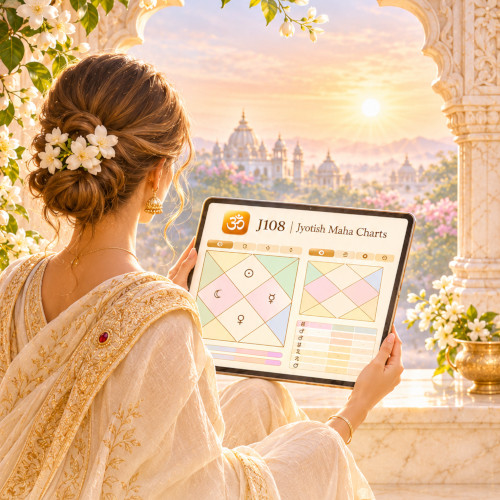
A Vedic birth chart, called a kundli or janma kundali, can look intimidating the first time you see it. There is a square or diamond filled with numbers, abbreviations and planet names, and no obvious place to begin. The good news is that every chart can be read in the same order. Once you know the order, the picture starts to make sense.
This guide walks you through five steps. It is written for beginners, so each term is explained in plain language. Remember that Jyotish is best used as a framework for reflection, and that traditions differ in the details.

Amber subscription
- Chart management
- Chart reports and interpretations
- Horoscope matching
- Vargas up to D-60
- Varshaphal, Prasna, Muhurta
- Bhava Chalit and Jaimini Chakras
- 4 Dasas with up to Pratyantardasa
- Basic Gochara and Panchanga search

Emerald subscription
Everything in Amber +
- Transsaturns, Upagrahas
- Vargas up to D-150 and all Chakras
- Mathematical rectification technics
- All Dasas with up to Pranadasa
- Detailed Ashtakavarga calculation, Shadbala
- Full-featured Gochara, Muhurta, Panchanga search
- All settings available in JMC Calculator

Ruby subscription
Everything in Emerald +
- 180 tokens included
- Deep dive analysis with AI assistant
- Jyotish Diary included
- Increased bonus for each affiliate in our affiliate program
- Research feature JMC Databank
- Unlimited chart quota
- Auto calculations for muhurta and rectification
Before you begin: what a kundli shows
A kundli is a map of the sky at the exact moment and place of your birth, drawn from the point of view of the Earth. It records where the Sun, Moon, five visible planets and the two lunar nodes (Rahu and Ketu) stood against the twelve zodiac signs. Vedic astrology uses the sidereal zodiac, which is why the signs often differ from the ones you know from Western horoscopes. If you want the background, our guide to sidereal vs tropical zodiac explains it simply.
You need your date, time and place of birth. A few minutes can change the rising sign, so use the most reliable time you have.
Step 1: Find your rising sign (Lagna)
The Lagna, or rising sign, is the zodiac sign that was rising on the eastern horizon at the moment you were born. It changes roughly every two hours, which is why birth time matters so much.
In Jyotish the Lagna is the starting point of the whole chart. It becomes your first house, and every other house is counted from it. Traditionally it describes your body, temperament and the way you approach life. If the chart is a house, the Lagna is the front door.
Step 2: Note your Moon sign and birth star
Next, find the sign where the Moon was placed. This is your Moon sign, or Rashi. For many Vedic astrologers it is as important as the Lagna, because the Moon represents the mind, emotions and the way you experience the world. Our article on what a Moon sign is and why it matters goes deeper.
Then look at the nakshatra, the lunar mansion the Moon occupied. There are 27 nakshatras, each covering a slice of the zodiac, and each has a ruling planet. Your birth nakshatra gives a more detailed portrait of the Moon and, as we will see in Step 5, it also sets the starting point of your planetary periods. You can read more in The 27 Nakshatras: A Complete Guide to Your Birth Star.
Step 3: Understand the twelve houses
The chart is divided into twelve houses (bhavas). Each house is a department of life. In the traditional scheme they are commonly summarised like this:
- 1st house: self, body, general approach to life
- 2nd house: family, speech, resources
- 3rd house: effort, courage, siblings and communication
- 4th house: home, mother, inner peace
- 5th house: creativity, children, learning
- 6th house: daily work, service, obstacles
- 7th house: partnerships and close relationships
- 8th house: change, transformation, hidden matters
- 9th house: purpose, teachers, higher learning, fortune
- 10th house: career and public role
- 11th house: gains, friends, networks
- 12th house: rest, letting go, spirituality, foreign lands
Charts are drawn in different styles. In the North Indian style the houses stay in fixed positions and the signs move around them. In the South Indian style the signs stay in fixed boxes and the Lagna is marked. Both show the same information, so choose whichever feels natural to you.
Step 4: See where the planets are
Now place the planets. For each one, notice two things: the sign it occupies and the house it sits in.
Each planet has a character. The Sun is about vitality and purpose, the Moon about feelings, Mars about drive, Mercury about thinking and communication, Jupiter about growth and wisdom, Venus about relationships and pleasure, and Saturn about discipline and time. Rahu and Ketu are the lunar nodes, often described as areas of craving and detachment.
A simple way to read a planet is to combine three ideas: what the planet represents, which sign it is in (how it behaves there) and which house it occupies (where in life this plays out). For instance, Mercury in the 3rd house of communication is a natural fit for writing and learning, while the same Mercury in another house will express itself differently.
Also note which houses each planet rules. Every sign belongs to a planet, so the sign on each house cusp tells you which planet is the lord of that house. Beginners can start with the Lagna lord, the planet ruling the rising sign, and see where it sits.
Step 5: Check your planetary period (dasha)
Jyotish has a built-in timing system. The most widely used is Vimshottari Dasha, a 120-year cycle shared among nine planets. It starts from the Moon's nakshatra at birth, so a planet becomes the "ruler" of a particular chapter of life. When that period begins and ends depends on your chart.
The planet ruling the current period is said to colour the themes of that time, which is why astrologers look at it alongside transits. Treat it as a way to reflect on what a phase may be asking of you, not as a fixed forecast. We cover the system in detail in our next guide, Vimshottari Dasha Explained.
Putting it together
Write your notes as a few plain sentences: your rising sign and its lord, your Moon sign and nakshatra, the houses of your key planets and your current period. Jyotish rewards patience, and a chart is read as a whole, so avoid dramatic conclusions from a single placement.
Frequently asked questions
Do I need my exact birth time? It helps a great deal. The rising sign and houses depend on it. If your time is approximate, the Moon sign and many planetary positions are still useful, but treat house-based conclusions with caution.
Why is my Sun sign different in Vedic astrology? Because of the sidereal zodiac, for many people the Sun shifts back by about one sign compared with the tropical zodiac used in Western astrology. Neither is "wrong". They are different systems. See What Is Vedic Astrology? for an overview.
Can a chart tell me exactly what will happen? No. Jyotish describes tendencies and timing, and many practitioners treat it as a tool for self-understanding. It is not a substitute for professional medical, legal or financial advice.
Try it with your own chart
Reading a chart is easier when you can see it. The JMC Calculator builds your kundli in the Vedic tradition and includes an "I am new to Jyotish" option with simpler explanations. You can start with the free demo, and you can also ask SIVA, our AI assistant at j108.net/chat, to explain your chart in plain English, one placement at a time.

Amber subscription
- Chart management
- Chart reports and interpretations
- Horoscope matching
- Vargas up to D-60
- Varshaphal, Prasna, Muhurta
- Bhava Chalit and Jaimini Chakras
- 4 Dasas with up to Pratyantardasa
- Basic Gochara and Panchanga search
Emerald subscription
Everything in Amber +
- Transsaturns, Upagrahas
- Vargas up to D-150 and all Chakras
- Mathematical rectification technics
- All Dasas with up to Pranadasa
- Detailed Ashtakavarga calculation, Shadbala
- Full-featured Gochara, Muhurta, Panchanga search
- All settings available in JMC Calculator
Ruby subscription
Everything in Emerald +
- 180 tokens included
- Deep dive analysis with AI assistant
- Jyotish Diary included
- Increased bonus for each affiliate in our affiliate program
- Research feature JMC Databank
- Unlimited chart quota
- Auto calculations for muhurta and rectification
Other articles in this category
- Srila Prabhupada's horoscope: Saggitarius or Capricorn? 5 June 2023
- The death of Princess Diana in the car accident. Jyotish astrological analysis 7 June 2023
- Leonardo DiCaprio. A story of success in Rahu and Jupiter Mahadasa 16 June 2023
- Louis Pasteur. Microbilogy combinations in Jyotish 22 June 2023
👉 How to Read Your Vedic Birth Chart (Kundli) Step by Step
You may also like




First time on this website? 👉 Get to know more about us! 👈


 Digest


Comments (0)