Read soon
-
Ежеквартальный дайджест #4/2026-2

The 9 Planets (Navagraha) in Vedic Astrology: Meanings at a Glance

In Vedic astrology, nine bodies take the leading roles in every birth chart. They are called the Navagraha, from nava, "nine", and graha, "that which seizes" or "grasps". The word suggests something that holds our attention, and in Jyotish each graha is thought of as an influence on a particular part of life. This guide gives you a calm, beginner-friendly overview of all nine. Use it as a quick reference when you open your own chart.
A note before we start. Jyotish is best used as a framework for reflection. The meanings below are traditional symbolism, not predictions, and different schools and regions emphasize different things.
How to Find Your Vedic Rising Sign (Lagna)
If you open a Vedic birth chart for the first time, the very first thing a Jyotish reader looks for is not the Sun or the Moon. It is the Lagna, the rising sign. In Western astrology the same point is called the Ascendant. In Jyotish it is the starting point of the whole chart, the place from which every house is counted. This guide explains what the Lagna is, why it needs an accurate birth time, and how you can find yours in a few minutes.
As always, Jyotish is best used as a framework for reflection. Nothing here is a prediction, and traditions differ in the details.
Find Your Moon Nakshatra: Free Birth Star Calculator
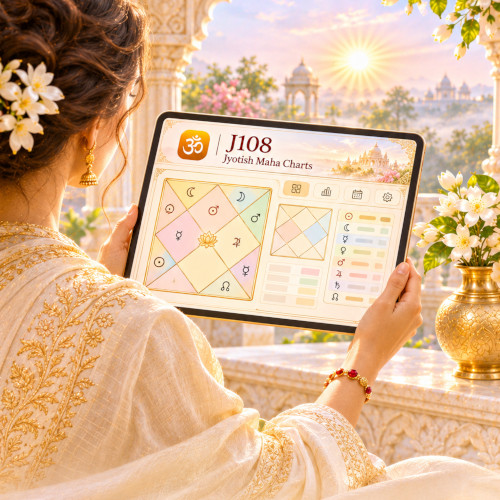
Ask a Jyotish reader about your "birth star" and they will be asking about your Moon nakshatra. It is the lunar mansion, one of 27, that the Moon occupied when you were born. Many people find it more personal than a Sun sign, and it plays a central role in Vedic astrology, from naming traditions to planetary periods. This page shows you how to find yours, in three steps, with the free demo of the JMC Calculator.
Jyotish is best used as a framework for reflection. Your nakshatra is a lens for self-understanding, not a verdict, and traditions vary in how they describe each one.

Amber subscription
- Chart management
- Chart reports and interpretations
- Horoscope matching
- Vargas up to D-60
- Varshaphal, Prasna, Muhurta
- Bhava Chalit and Jaimini Chakras
- 4 Dasas with up to Pratyantardasa
- Basic Gochara and Panchanga search

Emerald subscription
Everything in Amber +
- Transsaturns, Upagrahas
- Vargas up to D-150 and all Chakras
- Mathematical rectification technics
- All Dasas with up to Pranadasa
- Detailed Ashtakavarga calculation, Shadbala
- Full-featured Gochara, Muhurta, Panchanga search
- All settings available in JMC Calculator

Ruby subscription
Everything in Emerald +
- 180 tokens included
- Deep dive analysis with AI assistant
- Jyotish Diary included
- Increased bonus for each affiliate in our affiliate program
- Research feature JMC Databank
- Unlimited chart quota
- Auto calculations for muhurta and rectification
Vimshottari Dasha Explained: How Planetary Periods Shape Your Life

Western astrology often focuses on where the planets were at birth and where they are today. Vedic astrology adds a third layer that many beginners find surprising: a built-in calendar of planetary periods. These periods are called dashas, and the most widely used system is Vimshottari Dasha.
If your birth chart is a map, the dasha system is a timeline that shows which planet is "in charge" of which chapter of life. This guide explains how it works in plain language, and how to approach it calmly.
How to Read Your Vedic Birth Chart (Kundli) Step by Step
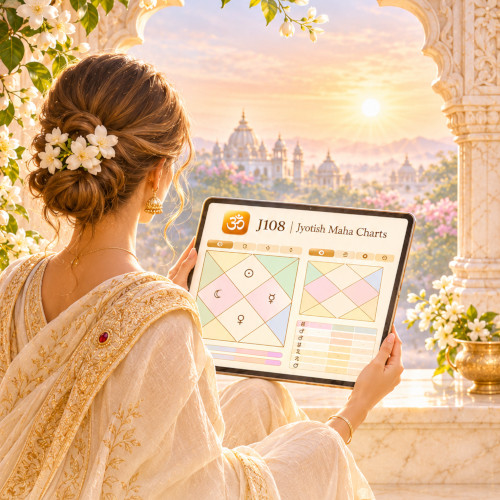
A Vedic birth chart, called a kundli or janma kundali, can look intimidating the first time you see it. There is a square or diamond filled with numbers, abbreviations and planet names, and no obvious place to begin. The good news is that every chart can be read in the same order. Once you know the order, the picture starts to make sense.
This guide walks you through five steps. It is written for beginners, so each term is explained in plain language. Remember that Jyotish is best used as a framework for reflection, and that traditions differ in the details.
Vedic Horoscope 2027: Year-Ahead Themes for Each Moon Sign

As the year draws to a close, many people look for a horoscope for the months ahead. Vedic astrology has a particular way of building a year-ahead reading, and it starts with your Moon sign (Rashi) rather than the Sun sign you know from newspapers. This guide explains how the method works and offers a gentle reflection theme for each of the twelve Moon signs.
A note on tone before we begin. Jyotish is best used as a framework for reflection. Nothing here is a prediction, and nothing replaces professional medical, legal or financial advice.
Sade Sati Explained: Saturn's 7.5 Years and How to Get Through Them

Few terms in Vedic astrology create as much worry as Sade Sati. Search for it and you will find dramatic warnings. Yet many experienced Jyotish teachers describe it in quieter terms: a long season in which life asks for patience, responsibility and honesty. This article explains what Sade Sati is, how it is calculated and how to approach it calmly.
The 27 Nakshatras: A Complete Guide to Your Birth Star

Nakshatras are one of the most distinctive and beautiful features of Vedic astrology. If your Moon sign tells you where the Moon was, your nakshatra tells you exactly which "lunar mansion" it was visiting. This guide introduces the full set of 27 nakshatras, their ruling planets and how to find your own birth star.
What Is a Moon Sign (Rashi) and Why It Matters in Jyotish

If you have ever read a Vedic horoscope, you have probably noticed that it begins with the Moon. In Jyotish, the Sanskrit word for the Moon sign is Rashi (also written Raashi or Rasi), and for many practitioners it is the most personal sign in the whole chart. This guide explains what a Moon sign is, why it often differs from the Sun sign you know from newspapers, and how to find yours.
Sidereal vs Tropical Zodiac Explained Simply

Open a Western horoscope and a Vedic one side by side and the planets often appear in different signs. The reason is not a calculation error. It comes down to two ways of drawing the same twelve-part zodiac: the tropical zodiac and the sidereal zodiac. Once you understand the difference, a lot of confusion about "my real sign" disappears. This article explains it step by step, without jargon.

 Digest


