The 9 Planets (Navagraha) in Vedic Astrology: Meanings at a Glance

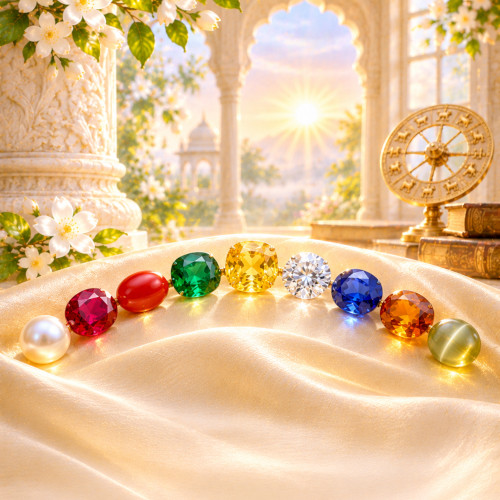
In Vedic astrology, nine bodies take the leading roles in every birth chart. They are called the Navagraha, from nava, "nine", and graha, "that which seizes" or "grasps". The word suggests something that holds our attention, and in Jyotish each graha is thought of as an influence on a particular part of life. This guide gives you a calm, beginner-friendly overview of all nine. Use it as a quick reference when you open your own chart.
A note before we start. Jyotish is best used as a framework for reflection. The meanings below are traditional symbolism, not predictions, and different schools and regions emphasize different things.

Amber subscription
- Chart management
- Chart reports and interpretations
- Horoscope matching
- Vargas up to D-60
- Varshaphal, Prasna, Muhurta
- Bhava Chalit and Jaimini Chakras
- 4 Dasas with up to Pratyantardasa
- Basic Gochara and Panchanga search

Emerald subscription
Everything in Amber +
- Transsaturns, Upagrahas
- Vargas up to D-150 and all Chakras
- Mathematical rectification technics
- All Dasas with up to Pranadasa
- Detailed Ashtakavarga calculation, Shadbala
- Full-featured Gochara, Muhurta, Panchanga search
- All settings available in JMC Calculator

Ruby subscription
Everything in Emerald +
- 180 tokens included
- Deep dive analysis with AI assistant
- Jyotish Diary included
- Increased bonus for each affiliate in our affiliate program
- Research feature JMC Databank
- Unlimited chart quota
- Auto calculations for muhurta and rectification
Why nine, and why "graha"?
Seven of the nine are visible in the sky: the Sun, the Moon, Mars, Mercury, Jupiter, Venus and Saturn. The other two, Rahu and Ketu, are not physical planets. They are the two lunar nodes, the points where the Moon's path crosses the Sun's apparent path. Jyotish treats them as shadow planets, and they have their own character.
The word graha is broader than the Western word "planet". It includes the luminaries (Sun and Moon) and the nodes, so "planet" is a convenient shorthand rather than an exact translation.
The nine planets at a glance
1. Sun (Surya)
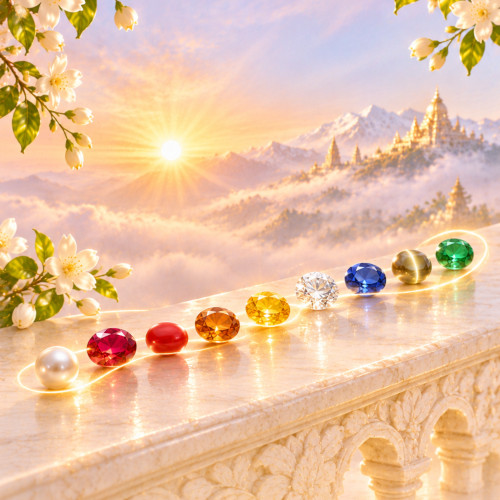
The Sun is the king of the chart. It symbolizes the soul, vitality, purpose, authority and the relationship with father figures. A well-placed Sun is traditionally associated with confidence and clarity, while a challenged Sun asks us to look at ego and self-worth. Its day is Sunday and its gem in the traditional system is ruby.
2. Moon (Chandra)
The Moon represents the mind, emotions, nourishment and the mother. Because it moves fastest, it is central to timing in Jyotish. Your Moon sign and your Moon nakshatra are among the most personal parts of your chart. Its day is Monday and its gem is pearl. To go deeper, read our guide to the Moon sign (Rashi).
3. Mars (Mangala)
Mars is the planet of energy, courage, action and drive. It is linked with physical vitality, competition, siblings and property. Traditional texts describe it as warrior-like, and it asks us to channel energy with discipline. Its day is Tuesday and its gem is red coral.
4. Mercury (Budha)
Mercury rules intellect, speech, learning, trade and communication. It is considered youthful and adaptable, connected to curiosity, writing and analysis. Its day is Wednesday and its gem is emerald.
5. Jupiter (Guru)
Jupiter is the great teacher, a symbol of wisdom, guidance, faith, children and generosity. Many traditions regard it as the most benevolent planet. It is associated with growth and expansion of understanding. Its day is Thursday and its gem is yellow sapphire.
6. Venus (Shukra)
Venus stands for love, beauty, art, comfort and partnership. It is connected with relationships, creativity, refinement and enjoyment of life. Its day is Friday and its gem is diamond, with white sapphire and other stones used in some traditions.
7. Saturn (Shani)
Saturn is the planet of discipline, time, responsibility, patience and long-term effort. Jyotish often describes it as a strict teacher: its lessons can feel slow, but they are associated with maturity and lasting results. Its day is Saturday and its gem is blue sapphire. If you have heard about the seven-and-a-half-year Saturn cycle, our article on Sade Sati explains it calmly.
8. Rahu (the North Node)
Rahu is a shadow planet linked with ambition, desire, curiosity, foreign things, technology and unconventional paths. Traditional texts describe it as insatiable: it pulls us toward new experiences and the unfamiliar. Its gem is hessonite, a honey-amber garnet.
9. Ketu (the South Node)
Ketu is the other shadow planet, linked with detachment, spiritual insight, intuition and letting go. Where Rahu reaches outward, Ketu turns inward. Its gem is traditionally cat's eye. Rahu and Ketu sit exactly opposite each other in every chart, like two ends of one axis.
Quick reference table
| Planet | Sanskrit name | Common keywords | Day |
|---|---|---|---|
| Sun | Surya | soul, vitality, purpose | Sunday |
| Moon | Chandra | mind, emotions, nourishment | Monday |
| Mars | Mangala | energy, courage, action | Tuesday |
| Mercury | Budha | intellect, speech, trade | Wednesday |
| Jupiter | Guru | wisdom, guidance, growth | Thursday |
| Venus | Shukra | love, beauty, harmony | Friday |
| Saturn | Shani | discipline, time, patience | Saturday |
| Rahu | Rahu | ambition, desire, the unfamiliar | none |
| Ketu | Ketu | detachment, insight, release | none |
Friends, enemies and strength
Jyotish does not treat planets in isolation. Texts describe natural friendships between planets: for example, the Sun, Moon and Mars are generally described as friendly toward one another, while Venus and Saturn are described as friendly toward Mercury. Planets can also be exalted, debilitated or placed in their own sign, which changes how comfortably they express themselves. Schools differ in the details, so treat any table you see as a starting point.
How the nine planets shape timing
Jyotish also uses the planets as a calendar. In the Vimshottari system, each planet governs a "period" of life called a dasha, and the sequence runs through all nine. This is why a planet's overall character matters even when it seems quiet in the chart. We explain the system in Vimshottari Dasha explained.
How to look at the Navagraha in your own chart
A simple routine works well for beginners:
- Open your chart and list the sign each planet occupies.
- Note the house each planet sits in.
- Look for the Moon and the Lagna first, then the Sun.
- Read one planet at a time instead of all nine at once.
- Write down questions, and look for patterns over weeks rather than hours.
The JMC Calculator builds your chart in the Vedic tradition, and its "I am new to Jyotish" option adds simpler explanations. For a full walk-through of reading a chart, see our guide to reading your kundli step by step.
Frequently asked questions
Are Rahu and Ketu real planets? No. They are mathematical points, the lunar nodes, where the Moon's orbit crosses the ecliptic. Jyotish gives them the status of grahas because of their symbolic and timing importance, especially in the dasha system and around eclipses.
Which planet is the most important? No single planet decides everything. The Lagna lord, the Moon and the planet ruling the current dasha are often given special attention, and a reading looks at how all nine work together.
Meet your nine planets
The Navagraha are the cast of characters in your birth chart. To see where yours stand, try the free demo of the JMC Calculator, then ask SIVA, the AI assistant, to explain any planet or house in simple language. It is a friendly way to turn a list of symbols into something you can reflect on.
Amber subscription
- Chart management
- Chart reports and interpretations
- Horoscope matching
- Vargas up to D-60
- Varshaphal, Prasna, Muhurta
- Bhava Chalit and Jaimini Chakras
- 4 Dasas with up to Pratyantardasa
- Basic Gochara and Panchanga search
Emerald subscription
Everything in Amber +
- Transsaturns, Upagrahas
- Vargas up to D-150 and all Chakras
- Mathematical rectification technics
- All Dasas with up to Pranadasa
- Detailed Ashtakavarga calculation, Shadbala
- Full-featured Gochara, Muhurta, Panchanga search
- All settings available in JMC Calculator
Ruby subscription
Everything in Emerald +
- 180 tokens included
- Deep dive analysis with AI assistant
- Jyotish Diary included
- Increased bonus for each affiliate in our affiliate program
- Research feature JMC Databank
- Unlimited chart quota
- Auto calculations for muhurta and rectification
Other articles in this category
- Why Jupiter rules 9th and 12th house of the natural zodiac? 19 June 2023
- Have you ever wondered why Mercury gets Diblaba in the 1st house? 22 June 2023
- What Is Vedic Astrology? A Beginner's Guide to Jyotish 26 October 2026
- Vedic vs Western Astrology: Why Your Sign May Be Different 2 November 2026
- Sidereal vs Tropical Zodiac Explained Simply 3 November 2026
👉 The 9 Planets (Navagraha) in Vedic Astrology: Meanings at a Glance
You may also like
First time on this website? 👉 Get to know more about us! 👈

 Digest


Comments (0)