 Calculator
 Nakshatra Krittika
Auspicious activities
Fire worship; Purification rites; Giving up old habits; Making swift changes and sudden endings; Acts requiring initiative, courage, leadership and executive ability; Making important decisions; Military Activities and Interests; Debating; Standing up for oneself; Cooking; Sewing and Embroidery; Cuffing; Shaving; All activities involving the use of fire or heat; All mothering and nurturing activities; Good for starting educational ventures; Good for commencing new ventures in general; Good for activities requiring a sense of discrimination, honesty and frankness; Drumming and Percussion; Most activities are favourable in this nakshatra.
Inauspicious activities
Socializing; Diplomatic activities; Rest or relaxation; Water based.
It is clear that the English word 'critical', has its roots in the Sanskrit word 'Krittika' and this one word sets the tone for Krittika's basic nature and functioning. Krittika's piercing quality lends itself to the criticizing and fault finding part of human nature. Krittika aims to get to the root of any action or situation and consequently it comes across all the imperfections, which often lie between the apparent and the real. Krittika doesn't tolerate imperfections because it sees them as obstacles in achieving its decidedly fixed goals.
Planets placed in Krittika give one pointed action and fiery bursts of energy. They act in a sudden and explosive manner Krittika natives have a direct and straightforward approach and don't tike to beat about the bush. They usually have cutting and blunt manners which often offends or intimidates those around them. One must however remember that Krittika natives are good at putting up social graces and do not act in a cutting or sharp manner all the time. They do so only when roused. They have an extreme temper, but it does not last for more than a few seconds.
Krittika exemplifies Sun's anger rather than Mar's anger. Sun's anger doesn't last for very long, while Mar's anger lingers on with an avenging attitude. The King (Sun), does not need to stay angry for long to declare war, while the Soldiers (Mars), who actually fight the battle, need sustained anger to keep them interested in battles.
Krittika natives usually hide their caring, nurturing and maternal side beneath hard, stern exteriors. Fire, despite its dangerous and destructive potential, cooks our food, warms us up on a cold day and helps make most of the things we require for a comfortable living. In other words fire is what makes civilization possible. Going one step further, we find that Sun's fire makes life possible on earth. This is the reason why Krittika natives are usually the life-sustaining element within their social sphere. They like to support others around them through their warmth, independence and will-power. In some cases this may be excessive and the result is similar to overcooked food. Krittika natives can alienate those around them by their sharp tongue and nature even though they don't have any real malefic intent.
In the universal scheme of things, Krittika relates to «daharta shakti» — the power of the astral body to cut its ties with the physical body. Its symbolism has heat above and light below. This relates Krittika to all the functions of fire — purification, cooking, melting, moulding etc. Fire also suggests the creative potency of the nakshatra and it is said to have a strong association with the Moon. In this way the Moon represents a receptive field or channel through which the creative potential of the Sun can unfold. Krittika only acts when it has some kind of direction to go in and so individuals with the nakshatra prominent in their charts, have a peculiarly startling and sudden way of erupting when their Krittika energy is activated.
On a spiritual level this nakshatra can provide intense awareness and allows one the ability to undergo extreme forms of purification. On a spiritual level Krittika is forever devoted to cutting its way along a clear path towards the development of one's true inner nature and therefore will slay any obstruction, inner or outer which blocks its path. When it is strong in a nativity it indicates sudden transformations/ups and downs in life.
| Planetary ruler | Surya |
|---|---|
| Deity | Karttikeya, the commander of the celestial godly forces, is the primary ruling deity of this asterism. He is one of the most prominent among Shiva'ssons and was raised by the aforementioned Krittikas (the seven wives of the seven celestial sages). As we can see the name «Krittika» and «Karttikeya» have common roots, and it is automatically implied that Krittikas are the foster mothers of a boy called Karttikeya. Thus this nakshatra is related to foster care and nurturing of all types. The circumstances preceding Karttikeya's birth, as mentioned in Puranic texts, are as follows: «At one point in time, the gods had lost all of their territory to the demons, and in their desperation asked Lord Shiva to help them. Shiva expressed his disability to intervene directly, but promised that he would produce a son who would deal with their problems. There are many different versions on how Karttikeya was actually born (please refer to the Esoteric section for a common version). However all texts agree with the fact that he was sent away to the Krittikas (Pleiades star cluster) in order to hide him from the demons. The demons had come to know that this child was bom for destroying them and were searching all over to find him, so that they could destroy him first, while he was still a baby. Hidden from everyone's eyes, the seven wives of the seven rishis took care of Karttikeya, and as soon as he reached boyhood, he fulfilled his purpose by destroying the demonic forces and restoring the heavens to the gods.» If properly understood, all of Krittika's nature and functioning can be understood from the above legend. Krittika relates to a sense of imminent danger, which leads to secrecy, seclusion and hiding as a result. It relates to the care and nurturing of anything in its young, delicate state and this is the reason why Moon reaches its maximum exaltation in the second pada of this nakshatra. Karttikeya's heroic valorous deeds are mirrored in its functioning as well. Agni, the god presiding over the «fire» element in nature, is the secondary ruler of Krittika. Fieriness is definitely required for the combative and militaristic nature of this nakshatra, as suggested by the war general post of Karttikeya. The fire symbolism here can be interpreted at a variety of levels. On a physical level it represents the digestive fire, which converts the food we eat into usable energy. This makes Krittika an energetic and physically active asterism. On a mental plane, fire relates to the ability of the mind to assimilate new knowledge. The mental fire constantly seeks knowledge and experience in order to keep itself burning. This nakshatra therefore relates to curiosity and an inclination to venture out into unknown areas. On the astral and more subtle planes, fire relates to the purifying principle in nature. It burns away the karma from previous lives, so that a sense of unity with the original creative source may be achieved. Krittika, on an esoteric level, serves the function of purifying the soul through the fires of knowledge and experience. We must not forget the seven wives of the seven sages, as they represent the actual stars of this constellation. Krittika is a semi-maternal nakshatra and all its maternal qualities come from these seven women. These seven women can in a way be seen as the five senses, the mind and the consciousness. Their child Kartikeya, then represents the limitless perceptivity of the innocent mind. There are many legends associated with the reasons behind the separation of these wives from their husbands (the seven celestial sages). We will touch upon one of these legends in the Esoteric Section. In the meantime, we just need to acknowledge the fact that these seven wives trained and educated baby Karttikeya in the various systems of knowledge. This fact reveals the «educational» and «institutional» aspect of Krittika. Krittika is a sort of celestial training ground or university, where one receives training necessary to pursue one's life purpose. |
| Origin | Demonic |
| Activity | Active |
| Element | Earth |
| Guna | Rajas |
| Essence | Mobility |
| Character | Mild-fierce (mridu-tikshna) |
| Animal | Sheep |
| Dosha | Kapha |
| Gender | Female |
| Body parts | Hips, Loins and the Crown of the Head are the body parts related to this nakshatra. It is a primarily «Kapha» (watery) nakshatra. Its kapha quality must arise from its relationship with Venus, a primarily kapha planet. The fact that Moon, another kapha planet, finds maximum exaltation in this nakshatra, re-emphasizes this. Its ruling deity, Karttikeya, is supposed to have a lustrous body, which is normally associated with the kapha humor. |
| Symbol | Its main symbol is an axe, razor or any sharp edged instrument like a blade or knife. This symbolism obviously relates to its name, which implies cutting and penetration. All sharp instruments can be used for both constructive or destructive purposes. A knife, for example, can be used for cutting vegetables or hurting someone. In the same way, Krittika's penetration can be used for cutting through superficial layers of mental and emotional functionings. On the other hand, it can be used for causing harm out of anger or enmity. In some cases, its destructive aspect is constructive from a universal point of view, especially when those at the end of the blade are crooked or evil. A flame of any type is another widely used symbol for Krittika. This as we shall see in the next section, relates to its association with Agni, the lord of the fire element. Peacock is another alternative symbol of this nakshatra. The elaborately ornate feathers of the male peacock relate to the exuberant martial nature of the masculine part of this nakshatra. A peacock is the chosen vehicle of the male ruling deity of this nakshatra (please refer to the image). Krishna always wore a peacock feather on top of his head and his early life, under the care of his foster parents, reveals the essence of this nakshatra (refer to the Deity Section). |
| Vowels | The first pada or quarter of this asterism corresponds to «A» as in Arden. The second pada or quarter of this asterism corresponds to «Ее» as in Eagle. The third pada or quarter of this asterism corresponds to «Oo» as in Uzbekistan. The fourth pada or quarter of this asterism corresponds to «Ay» as in Elliott. In the Sanskrit alphabet Krittika corresponds to «I», «Oo» and «U» consequently its mantras are «Om Im», «Om Oo» and «Om U». |
| Enemy | Visakha |
Source: «The Book of Nakshatras» by Prash Trivedi
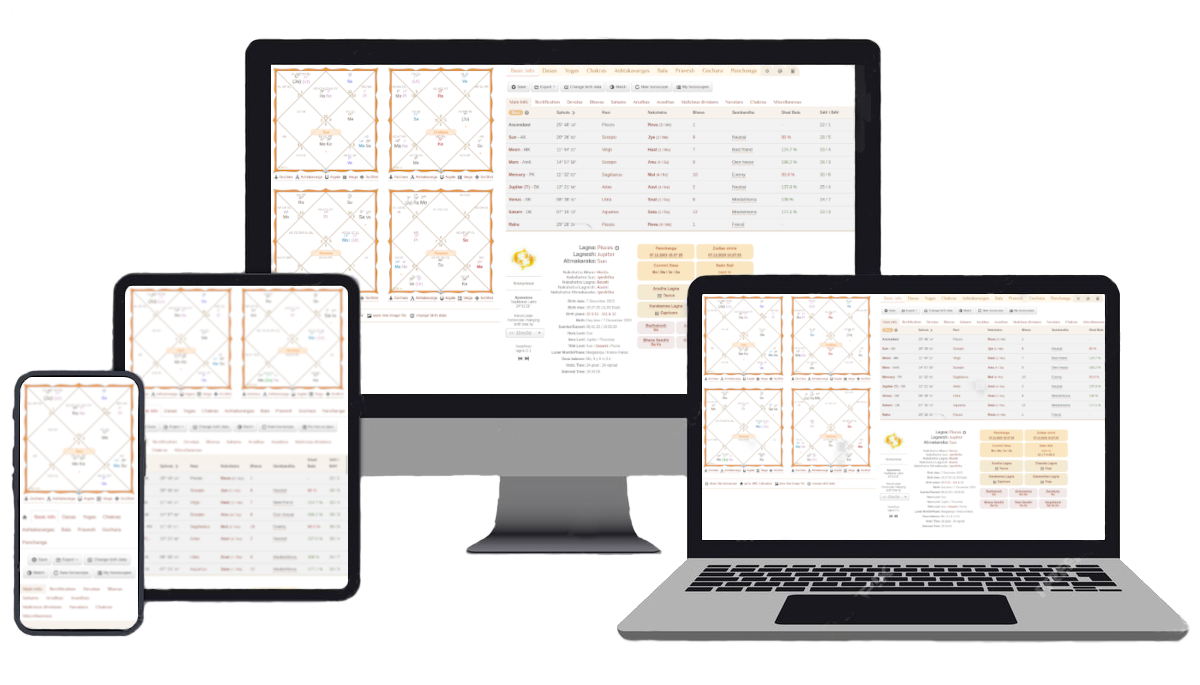

Amber subscription
- Chart management
- Chart reports and interpretations
- Horoscope matching
- Vargas up to D-60
- Varshaphal, Prasna, Muhurta
- 4 Dasas with up to Pratyantardasa
- Basic Gochara and Panchanga search

Emerald subscription
Everything in Amber +
- Transsaturns, Upagrahas
- Vargas up to D-150 and all Chakras
- Mathematical rectification technics
- All Dasas with up to Sookshmadasa
- Full-featured Gochara, Muhurta, Panchanga search
- Detailed Ashtakavarga calculation, Shadbala

Ruby subscription
Everything in Emerald +
- Research feature JMC Databank
- Jyotish Diary for 365 days included
- Auto calculations for muhurta and rectification
- Increased bonus for each affiliate in our affiliate program
- Unlimited tokens to use with SIVA Chatbot
- Unlimited chart quota


