 Calculator
 Nakshatra Purva Bhadra
Auspicious activities
All dangerous, uncertain and risky activities; All activities of a mechanical or technological nature; Holding funeral services; Putting an end to things; Exploring Death Issues; Agricultural activities; All activities connected with water like sailing etc.
Inauspicious activities
Generally unfavourable for most activities except those mentioned above; Especially unfavourable for beginning new things or initiations of all kinds; Not good for travelling, sex, marriage and dealing with the government or higher authorities. Most of the actions carried out under its influence often end up causing pain, anxiety, regret, sorrow or extreme difficulty.
If there is one word which could sum up this nakshatra it would be 'diabolical'. A lot of the so called negative human traits like paranoia, pessimism, debauchery, violence, hedonism, thirst for the macabre, lying, deceit, cruelty and morbidity can be ascribed to this nakshatra. This nakshatra is mainly concerned with transformation. Those under the strong influence of this asterism have the huge task of witnessing and understanding the lower dark side of life without getting their hands dirty.
Although most scholars don't recognise this fact, this is the most intense amongst all the nakshatras. Since all its negative aspects can only in essence be manifested through the ego, humility becomes the most important thing for Purvabhadrapada natives. One of the few good qualities of this nakshatra is that it is devoted to those it respects. This again however is a double edged sword, since many a times its object of veneration is not very wholesome.
Ramakrishna Paramahansa (the famous 19th century saint), who has his Moon in Purvabhadrapada, was devoted to Kali, the fierce goddess. The dark deity Kali, despite being fierce, is ultimately benevolent. This devotion helped him rise above all the negative Purvabhadrapada characteristics, but many under this nakshatra's influence take to worshipping demonic and devilish deities and spoil their karma for many lives. Thus we can see that it is very important for the natives under this nakshatra to find the right thing to get devoted to from the very beginning.
Another good quality of this nakshatra is that it is very sincere and hardworking, even if its goals are not so wholesome. It has tremendous perseverance and will go to any lengths to achieve its objective. In fact a lot of Purva Bhadrapada natives end up engaging in bad karma because they are ready to do 'just about anything' to obtain their objectives.
If a case study of mass murderers, homicides and genocides was carried out, it would be found that most of the people involved would have some strong connection with Purvabhadrapada. This nakshatra relates both to the persecuted and the persecutor.
More evolved souls usually use this nakshatra's energy to mortify themselves instead of others. All the sages like Vishwamitra, who underwent extreme penance, are basically utilising this nakshatra's energy. Even today in India, one can see a lot of sadhus involved in intense practices involving self torture and self mortification. A Purvabhadrapada native is ready to stand on one foot for ten years or even more, if they are convinced that it is going to bring them their desired result.
After reading the above description, the reader may be surprised to know that a lot of times Purvabhadrapada natives cannot be distinguished from the rest, just because they have a very strong capacity to fit in with the contemporary societal structure. They are normal people with nine to five office jobs, who speak, eat and dress like everyone else, and no one can suspect the kind of things they are up to in their private lives. They usually keep their idiosyncrasies and nefarious activities secret.
The only way of spotting a Purvabhadrapada person is their highly strung, nervous demeanour along with an overtly serious look. They are the ones who are likely to snap first in any confrontational situation. They however try to carry a happy look and act amicably in social gatherings.
They are basically two faced people, the kind who work on normal day jobs, and in the nights they can be found in fetish clubs, banging heads at hard core heavy metal concerts, entertaining macabre fantasies, practising dark tantric rituals or plotting and carrying out violent or criminal activities... Purvabhadrapada natives are very susceptible to extreme views and often end up being part of extreme fundamentalist groups.
Not every Purvabhadrapada person gives physical expression to their negative energies. The more evolved souls learn to fight the battle between light and dark within their own minds and hearts. Alot of common everyday Purvabhadra pada people, instead of being the perpetrators, end up being the victims. Creative artists who have this nakshatra strongly placed in their charts, can often be seen channeling its energy, by implementing all the dark side of life in their art, whether it be writing, music or drama.
Purvabhadrapada natives, like everything else, tend to oscillate between extremes in the sexual sphere. All kinds of sexual perversions and phobias are seen to originate in this nakshatra.
Regretfulness is another of the prominent qualities of this nakshatra. Being contemplative at some inner level, its natives are often seen brooding over the past, tormenting themselves for all the wrongs they have done.
On a material plane such natives are stingy in regards to money. However their one peculiarity is that they are always ready to place all of their wealth at the disposal of their spouse, partner, teacher or cause. Their capacity for revenge holds no equal among nakshatras. Once again Alexander Dumas's novel, «Count of Monte Christo», reveals how this emotion can be taken to the extreme.
In the universal scheme of things, Purvabhadrapada relates to «yajamana udyamana shakti» — the power to raise the evolutionary level. Its symbolism has humanity above, and the astral regions below. This imagery suggests that Purvabhadrapada acts as a bridge between the consciousness on the material and non-material planes. It is this bridge which is blocked in majority of the humanity in the present times. Purvabhadrapada has the power to raise one's evolutionary level through internal purification brought about by the raging celestial fires of penance.
| Planetary ruler | Guru |
|---|---|
| Deity | It has an obscure ruling deity with the name of Aja-Ekapada, which translates into «the one rooted goat». Its alternative meaning, which carries a cosmic pun, is «the one footed unborn one». This mysterious creature is a goatheaded monster with one leg, who forms part of the entourage of Rudra (the fierce form of Shiva). Surprisingly, Aja-Ekapada, a Vedic character, can be easily found on the card no. 15 in the Western Tarot pack. This card is called 'The Devil» and is supposed to signify the evil and dark side of life in general. This goat headed creature carries much of the same meanings from the Vedic point of view, except the fact that the destruction and ruin it brings is supposed to be divinely ordained. We can see that the name of this asterism also relates directly to this one footed deity. The sign Pisces is seen to symbolise feet and since this asterism has only one part in Pisces, it can be said to have only one foot. It is interesting to note that this one footed dark deity has gained enormous prominence in the present world age of Kali-Yuga. It can be seen in all major important centres of the Western civilization. All the secret societies and brotherhoods like the Freemasons, Qub of Rome and the I/luminati consider this goat god as their main deity. In these circles he is known as Baphomet. Since our present day world is run by a secret elite group, which has strong connections with the above mentioned secret societies, it is not hard to understand why there is so much unnecessary violence and bloodshed being perpetuated on our planet. Aja-Ekapada can be seen as the ruling deity of all types of black magic and that is why individuals deeply influenced by this asterism are attracted to or practise black magic. In the image representing this nakshatra, the reader can see skulls and bones lying all around, which form a secondary symbol for this asterism. One can see that the skull and bones symbol has always been associated with danger as it is displayed in dangerous places like high voltage areas etc. In this light it is interesting to note that there's a secret order in the United States known as the «Skulls and Bones Society», of which prominent American presidents have been members! Finally, the supreme ruling deity of this asterism is Rudra, the fierce form of Shiva. This asterism carries the destructive aspect of Shiva in much the same way as Ardra. The difference is that here Rudra represents the final dissolution on all planes, while in Ardra the chaotic destructive energy only operates on trie mental, emotional planes. As a result, this asterism can be much more cruel and merciless in comparison to Ardra. This can be said to be the place where the Universe loses its mind! This is basically a purificatory energy. When the old has fallen into decay it has to be destroyed for the new to take birth. The destructive fires of Rudra aim to achieve exactly that. On a more personal level, souls pay for their past life bad karmas through penance and retribution under the burning fires of this nakshatra. |
| Origin | Human |
| Activity | Passive |
| Element | Ether |
| Guna | Sattwa |
| Essence | Retention |
| Character | Fierce (ugra) |
| Animal | Lion |
| Dosha | Vata |
| Gender | Male |
| Body parts | It mainly relates to the Sides of the Body. This includes the Ribs, Abdomen and the Sides of the Legs. It is also an indicator of the Left Thigh and Soles of the Feet. It is interesting to note that patting the left thigh was considered an invitation for war or an aggressive act meant to cajole or humiliate others. In the Vedic epic Mahabharata, Duryodhana did a similar gesture when he asked Draupad/to come and sit on his thigh, and Bhimatook a vow to break off his thigh in battle and drink the blood from it (a very Purva bhadrapada act!) It is a predominantly Vata (Air) nakshatra in keeping with its expansive nature. |
| Symbol | Its main symbol is the 'front part of a funeral cot'. A funeral cot denotes our exit from the world. In astrology, the sign Pisces, or the 12th house in the chart signifies this exit. Since this asterism begins the sign of Pisces, it is appropriate that it is ascribed the front legs of the funeral cot. The front part of a normal sleeping bed can also be seen as the symbol of this asterism. Since the 12th house relates to sleep, which can be seen as a temporary form of death, a sleeping bed would also relate to this asterism. It signifies the moment in time when after doing our worldly duties and mingling with friends (Aquarian or 11th house activities), we prepare for retiring to bed in the night. Its alternative symbol is 'a man with two faces'. As you can see in the image for this nakshatra, one face wears a benign look while the other one appears mad, violent and destructive. This relates to the Jekylland Hyde character of this asterism. It can always put up a normal, socially acceptable and cheerful front on the outside while holding its darker side inside at all times. A 'sword' is also used as its symbol by many scholars. The sword obviously relates to the process of «cutting off», The cutting off process relates to the destructive, dissoluting side of nature and associates this nakshatra with all kinds of pains, injuries, accidents, deaths and endings. Another alternative symbol for this asterism is 'a single ray of Sun'. This relates to the gloomy, desolate aspect of this nakshatra where all hope is at the minimum and the light at the end of the tunnel is very faint. Those readers who are conversant with the novel «Count of Monte Christo» by Alexander Dumas, can easily see how this applies to the experience of the lead character Edmund Dantes, while he was imprisoned on the remote island of Elba. |
| Vowels | The first pada relates to «Se» as in the name «Seth». The second pada relates to «So» as in the name «Somalia». The third pada relates to «The» as in «Then». The fourth pada relates to «Di» as in the name «Divali». In the Sanskrit alphabet Purvabhadrapada corresponds to the letters «Vam» and «Sham», and consequently its mantras are «Om Vam» and «Om Sham». |
| Enemy | Uttara Phalguni |
Source: «The Book of Nakshatras» by Prash Trivedi
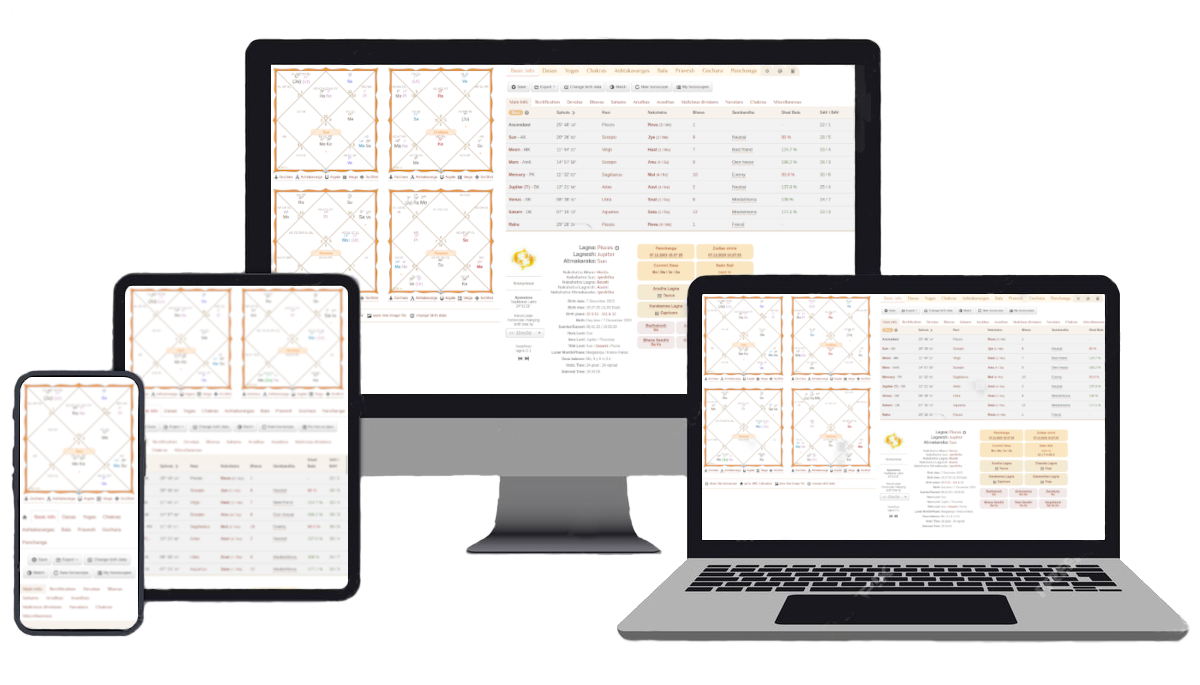

Amber subscription
- Chart management
- Chart reports and interpretations
- Horoscope matching
- Vargas up to D-60
- Varshaphal, Prasna, Muhurta
- 4 Dasas with up to Pratyantardasa
- Basic Gochara and Panchanga search

Emerald subscription
Everything in Amber +
- Transsaturns, Upagrahas
- Vargas up to D-150 and all Chakras
- Mathematical rectification technics
- All Dasas with up to Sookshmadasa
- Full-featured Gochara, Muhurta, Panchanga search
- Detailed Ashtakavarga calculation, Shadbala

Ruby subscription
Everything in Emerald +
- Research feature JMC Databank
- Jyotish Diary for 365 days included
- Auto calculations for muhurta and rectification
- Increased bonus for each affiliate in our affiliate program
- Unlimited tokens to use with SIVA Chatbot
- Unlimited chart quota


